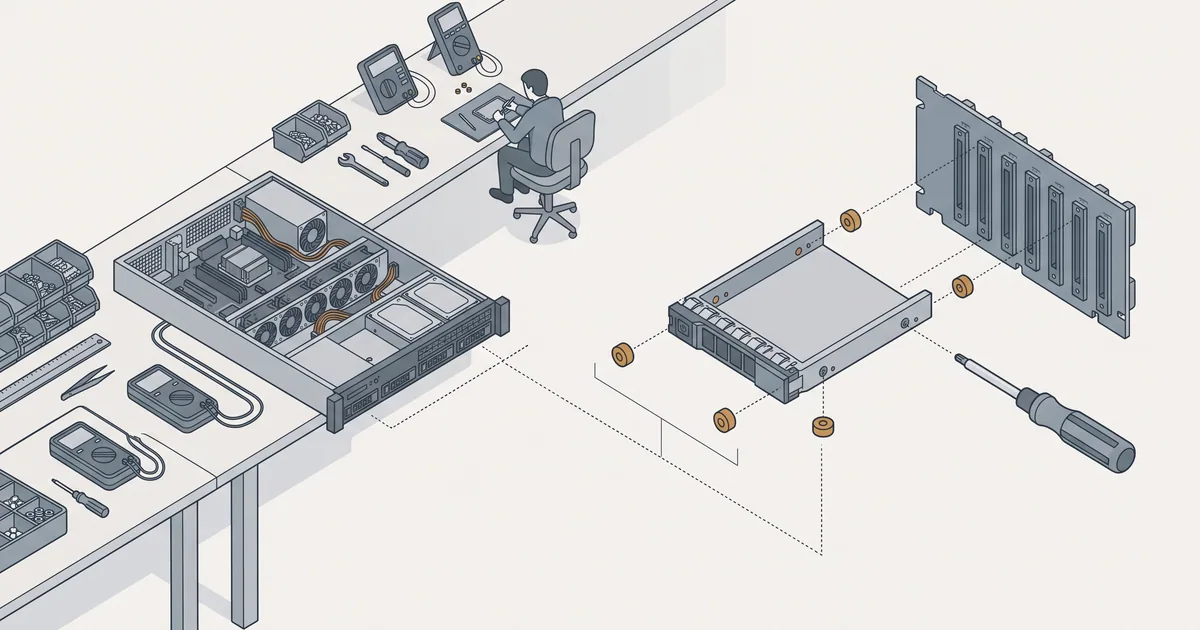
During May 2012, system architects deploying high-density storage arrays faced severe secondary drive dropouts during array reconstruction cycles. Empirical studies of hard disk drive mechanics and storage reliability demonstrate how rotational vibration, disk flutter, and acoustic energy degrade servo track-following accuracy inside multi-drive enclosures. When high-rpm hard drives and high-velocity cooling fans generate intense acoustic resonance, mechanical stress transmits through the SAS backplane directly into adjacent drive sleds. This phenomenon raises an urgent engineering problem: How do chassis acoustic vibration and aggressive RAID rebuild priorities combine to knock healthy disks offline during a single-drive recovery?
How does rotational vibration from chassis fans degrade head-positioning accuracy across dense drive bays?
Aerodynamic disk flutter and structural vibration in high-density hard disk drive enclosures directly induce track misregistration (TMR), forcing read/write heads off their narrow servo tracks during intensive I/O operations. Acoustic sound-power and mechanical vibration testing of hard disk drive assemblies demonstrates that unisolated chassis framing couples fan and spindle harmonics directly into adjacent drive bays. Hard disk drive reliability modeling confirms that correlating mechanical off-track errors with Self-Monitoring, Analysis and Reporting Technology (SMART) telemetry attributes provides vital early warning of impending drive failure. Furthermore, analyses of RAID reconstruction and background disk scrubbing show that unthrottled rebuild reads amplify latency and expose surviving disks to timeout-induced array dropouts when unrecoverable sector delays occur. Coupled spindle torque and cooling fan turbulence across shared SAS backplanes compound head-settling delays during synchronous multi-drive seeks. Consequently, elastomeric drive-carrier grommets, tuned fan pulse-width modulation curves, and bounded RAID rebuild queues are essential to keep enterprise disks within their servo track-following tolerances. In dense 24-bay and 36-bay 4U enclosures, chassis cooling fans operating at peak velocity couple with rotational torque from 7200 RPM enterprise drives to create complex multi-axis harmonics. Without matched isolation grommets and rigid chassis framing, off-track errors multiply rapidly across drive voice coil actuators. When drive heads deviate outside their narrow servo-track tolerances because of external acoustic energy, the disk controller must inhibit write gates or delay read head sampling until settling occurs. Under Linux software RAID (mdadm) or hardware MegaRAID adapters, an unconstrained rebuild commands sequential reads across surviving disk members at maximum queue depths. This saturates the SAS expander backplane, causing voice coil motor actuators in all drives to seek synchronously across platters. Unlike solid-state devices, magnetic platter assemblies remain vulnerable to coupled rotational oscillation, which triggers repeated head off-track re-seeks and inflates raw input/output wait times from milliseconds into seconds.
Why must disk error-recovery control timeouts match hardware or kernel RAID controller thresholds?
The critical failure boundary occurs between drive firmware error-recovery parameters and host controller command timeout policies. Enterprise drives implement Time-Limited Error Recovery (TLER) or Error Recovery Control (ERC), which forces the drive to abandon internal sector recovery after roughly seven seconds and report a read error to the RAID layer. Desktop drives, by contrast, attempt internal read retries and head recalibrations for up to two minutes. If a drive does not return status before the kernel SCSI subsystem or hardware RAID controller command abort threshold expires (commonly thirty seconds), the controller marks the physical drive dead and ejects it from the array. This timeout mismatch breaks the storage control-plane contract, turning transient acoustic track-following delays into a double-fault array failure during an active rebuild. In dense storage chassis, high airflow turbulence from axial fan walls also excites platter flutter, compounding head-positioning latency just when the array has zero redundancy margin. Modern telemetry exposed through SMART registers gives administrators early warning of physical track-following distress. Attributes such as Raw Read Error Rate (Attribute 01), Seek Error Rate (Attribute 07), and Hardware ECC Recovered (Attribute 195) spike when rotational vibration disrupts servo timing. Distinguishing true physical media wear from acoustic servo disruption requires correlating these raw counters against Reallocated Sector Counts (Attribute 05) and Current Pending Sector Counts (Attribute 197).
How should rebuild I/O bandwidth be throttled to protect live application read latency?
To prevent simultaneous multi-drive failure during an active reconstruction, operators must throttle background array synchronization and align timeout hierarchies. In Linux mdadm, adjusting `/proc/sys/dev/raid/speed_limit_max` caps synchronization throughput, preventing saturation of the storage backplane and dampening synchronous actuator seek resonance. Hardware RAID controllers provide corresponding background rebuild rate percentages, while `smartctl -l scterc,70,70` configures enterprise drives to return control within seven seconds. Balancing rebuild bandwidth preserves live application latency, avoids acoustic harmonic resonance across mechanical bays, and ensures surviving disks remain well inside their operational vibration envelope throughout recovery. As of May 2012, combining physical grommet isolation, aligned SCT Error Recovery Control timers, and throttled rebuild queues remains mandatory for surviving multi-terabyte RAID reconstructions.
Sources
- IEEE: Prediction of track misregistration due to disk flutter in hard disk drive, 2002-03-01
- SAGE Publications: Sound Power Testing of Hard Disk Drive Assemblies, 2001-03-01
- IEEE: Hard Disk Drive Reliability Modeling and Failure Prediction, 2007-09-01
- ACM: Disk Scrubbing Versus Intradisk Redundancy for RAID Storage Systems, 2011-07-01