During April 2012, wireless internet service providers face recurring network outages across remote communications sites as spring storm fronts sweep across regional landscapes. Field engineers frequently observe destroyed Ethernet physical layer transceivers and charred surge suppression boards, even at facilities equipped with modern inline gas-discharge arrestors. Contemporaneous investigations into lightning surge propagation emphasize that understanding transient overvoltages along outdoor signaling conductors is vital for telecommunications operators to prevent catastrophic equipment damage during spring thunderstorm seasons. This operational reality exposes a fundamental network vulnerability: Why do inline Ethernet surge protectors fail to save tower radios when the equipment shelter and tower steel have different ground potentials?
How does ground-potential rise during a nearby strike drive current through outdoor Ethernet runs?
Understanding lightning surge propagation dynamics is vital for telecommunications operators to prevent catastrophic overvoltages across exposed infrastructure during spring thunderstorm seasons. Accurate modeling of tower grounding response under high-voltage surges is essential to mitigate backflashover risks and maintain operational continuity across tower-mounted systems. High-voltage surge propagation studies demonstrate that tower grounding system impedance directly dictates transient overvoltage levels experienced by interconnected lines. Lightning protection analyses confirm that grounding electrode resistance directly governs the clamping effectiveness of surge arrestors on interconnected power and data lines. Furthermore, the frequency dependence of soil electrical parameters significantly alters the transient response and effective surge impedance of grounding electrodes during fast lightning discharge events. Surge voltages traveling along metallic shielding and signaling paths necessitate bonded grounding paths to prevent differential surge potentials across sensitive terminal interfaces. The failure of inline surge suppression stems directly from transient ground-potential rise occurring during a direct or nearby lightning strike. When lightning attaches to a communications tower, several tens of kiloamperes inject into the steel lattice. Because tower grounding system impedance directly dictates transient overvoltage levels experienced by interconnected lines, if the tower base earth electrode system is electrically isolated or remotely separated from the equipment shelter ground ring, a massive potential difference develops between the two structures. The shielded twisted-pair Ethernet cable connecting the masthead radio to indoor switches inadvertently becomes a low-impedance equalizing bridge, forcing lightning current through the cable shield and data pairs. Under these conditions, standard inline gas-discharge tubes and transient voltage suppressor diodes operate in an unintended conduction mode. While these arrestors successfully clamp differential voltages between conductors within the cable bundle, they bond the data conductors directly to the local chassis ground when triggered. If the masthead radio chassis is clamped to tower steel at a hundred kilovolts while the indoor shelter arrestor is bonded to an indoor ground bus at zero volts, the surge protector does not prevent current flow; it facilitates it. Without equipotential bonding between the tower and shelter, the discharge current traverses the cable foil, melts the drain wire, and vaporizes the isolation transformers of connected network interface cards.
Where must bulkhead gas-discharge arrestors and braided ground straps be bonded on the tower path?
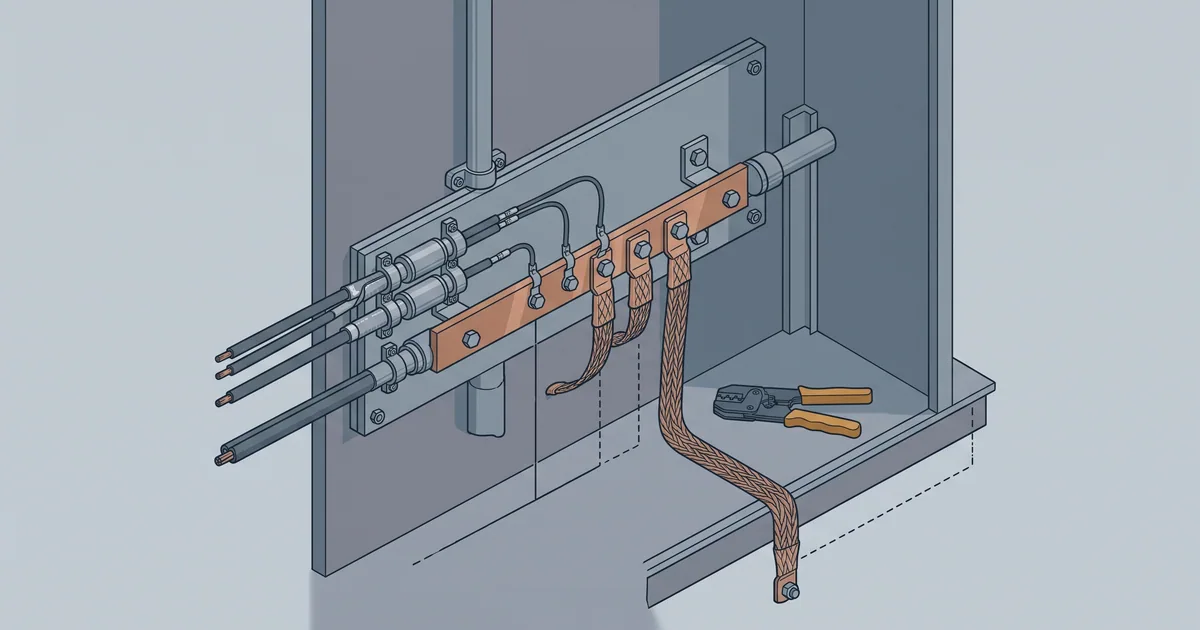
Remediating transient ground divergence requires an engineered bonding regime that enforces equipotential conditions along the entire transmission path. Outdoor-rated shielded twisted-pair cables must utilize bulkhead arrestors installed at defined structural boundaries: immediately below the masthead radio, at the tower base before transitioning to horizontal cable trays, and at the exterior entrance hatch plate of the equipment shelter. Because surge voltages traveling along metallic shielding and signaling paths necessitate bonded grounding paths to prevent differential surge potentials across sensitive terminal interfaces, bonding the cable shield to tower steel at the top and base shunts high-frequency energy into the structural lattice before it reaches indoor communications cabinets. Network engineers must balance physical protection against operational telemetry requirements, ensuring that suppression circuits do not degrade high-speed carrier signals. Power-over-Ethernet lines present distinct trade-offs because direct-current power feeds share conductors with high-frequency signaling transformers. Inadvertent shield currents induce common-mode voltages that corrupt Ethernet frames and trigger physical-layer link flap on critical wireless backhauls. Consequently, high-inductance wire jumpers fail to dissipate the fast front of a lightning impulse, reinforcing the necessity of wide tinned-copper bonding straps with minimal inductance connected to a unified perimeter ground ring. System resilience also depends on maintaining strict physical separation between lightning down-conductors and communication trunks.
What earth-resistance and continuity checks validate site grounding before storm season?
Site reliability audits prior to active thunderstorm seasons require rigorous validation using four-point fall-of-potential earth-resistance testing and clamp-on ground loop meters. Confirming a site resistance below five ohms is necessary but insufficient; field technicians must verify direct DC continuity between tower legs, cable entrance plates, and interior ground reference bars. As demonstrated by April 2012 engineering guidelines, surge arrestors cannot protect communications equipment in isolation. Only a unified equipotential bonding network prevents destructive ground potential rise from weaponizing Ethernet cabling against the very radios it powers.
Sources
- Elsevier BV: Analytical study on lightning surge propagation along rail and lightning overvoltages on railway signalling equipment, 2012-04-01
- Elsevier BV: Simplified HV tower grounding system model for backflashover simulation, 2012-04-01
- IEEE: Influence of grounding resistance on effectiveness of lightning protection for power distribution lines with surge arresters, 2010-09-01
- IEEE: Frequency Dependence of Soil Parameters: Experimental Results, Predicting Formula and Influence on the Lightning Response of Grounding Electrodes, 2012-04-01