During March 2012, data center network engineering teams deploying high-density top-of-rack switching fabrics encountered recurring operational puzzles when combining redundant 10-Gigabit Ethernet links using IEEE 802.3ad Link Aggregation Control Protocol (LACP). Contemporary literature on multipath routing and bottleneck link management emphasized the operational necessity of dynamic traffic distribution to avoid link saturation across concurrent transport paths. Despite configuring two physical 10GbE interfaces within a single aggregate bundle, production monitoring often recorded one member port running at line rate while the companion port remained virtually idle. Why does bonding two 10GbE uplinks fail to double throughput unless the switch hashing policy matches the traffic's tuple distribution?
Why does Layer-2 MAC hashing pin point-to-point trunk traffic onto a single physical member?
Research on multipath routing and bottleneck link management published in March 2012 emphasized the operational necessity of dynamic traffic distribution to avoid link saturation across concurrent transport paths. Analytical models of equal-cost multipath (ECMP) and link-aggregation hashing demonstrated that coarse header modulo-N and CRC assignments create severe underutilization on secondary paths while exhausting primary link capacity when header entropy is low. Data center flow-routing studies established that static path allocation fails to balance elephant flows effectively when hashing criteria do not match the underlying traffic tuple distribution. Empirical evaluations of IEEE 802.3ad Ethernet link aggregation on compute clusters demonstrated that workload distribution across parallel trunk channels requires multi-flow tuple diversity to prevent hot-spot formation on single physical links. Multi-interface balancing architectures confirmed that spreading traffic across multiple active interfaces requires granular flow-aware hashing beyond static Layer-2 endpoint associations. Bottleneck link management analysis confirmed that static mapping of concentrated traffic streams onto fixed aggregated channels results in persistent congestion on individual member links. The root cause of interface starvation inside an aggregated link lies in the deterministic hashing algorithms executed by switch application-specific integrated circuits (ASICs). When administrators rely on default Layer-2 Ethernet frame hashing, the forwarding engine calculates the egress physical port based strictly on source and destination Media Access Control (MAC) addresses. In routed top-of-rack architectures or hypervisor transit trunks, traffic directed toward upstream gateways or adjacent distribution switches inevitably shares the exact same gateway MAC address. Because the MAC pair never varies across routed egress frames, the hashing algorithm consistently yields the identical numerical index, pinning hundreds of distinct client sessions to a solitary physical member. This deterministic polarization exposes a stark operational paradox between aggregate theoretical capacity and practical link utilization. Evaluated across high-throughput server clusters, analytical models of multipath load balancing highlighted that rigid link allocation mechanisms create severe underutilization on secondary paths while exhausting primary link capacity. The physical link layer maintains synchronization and frame order compliance through IEEE 802.1AX-2008 specifications, yet the forwarding plane treats the trunk as an unshared conduit for any single MAC conversation. Consequently, bursty storage traffic, such as iSCSI or NFS exports communicating across identical gateway endpoints, experiences artificial packet queuing and dropped frames despite twenty gigabits of nominal provisioned bandwidth.
How does switching to Layer-3/Layer-4 tuple hashing balance multi-flow workloads across dual uplinks?
To unlock aggregated capacity, network engineers must align hashing criteria with multi-flow payload properties by configuring Layer-3 and Layer-4 tuple distribution algorithms. Modern enterprise switching platforms, including Cisco Catalyst and Nexus hardware or Juniper EX-series switches, allow link aggregation groups to inspect the IP protocol header and TCP/UDP port fields. By extracting the five-tuple consisting of source IP, destination IP, transport protocol, source port, and destination port, the forwarding ASIC introduces extensive entropy into the hash key generation. Individual connections among services or client requests produce unique numeric digests, dispersing concurrent flows evenly across both physical 10GbE interfaces while rigorously preserving packet ordering within each distinct stream. Selecting an advanced hashing policy demands careful consideration of control-plane versus data-plane boundaries and interface contracts. When configuring bonding modes on Linux hosts, using bonding mode 4 (802.3ad) in conjunction with the xmit_hash_policy layer3+4 directive ensures that the host kernel computes hashes over IP and transport headers rather than rudimentary Layer-2 identifiers. However, operators must verify that intermediate hardware supports deep header inspection at full 10Gbps line rate without pushing parsing operations to software exception paths. Furthermore, non-IP protocols, encapsulated frames, or fragmented packets lacking full transport headers automatically fall back to Layer-3 or Layer-2 hashing, requiring explicit telemetry monitoring via SNMP interface counters. Resilience under load also depends heavily on how dual uplinks terminate within the upstream switching fabric.
What fiber-pull fault tests verify sub-second LACP reconvergence under sustained load?
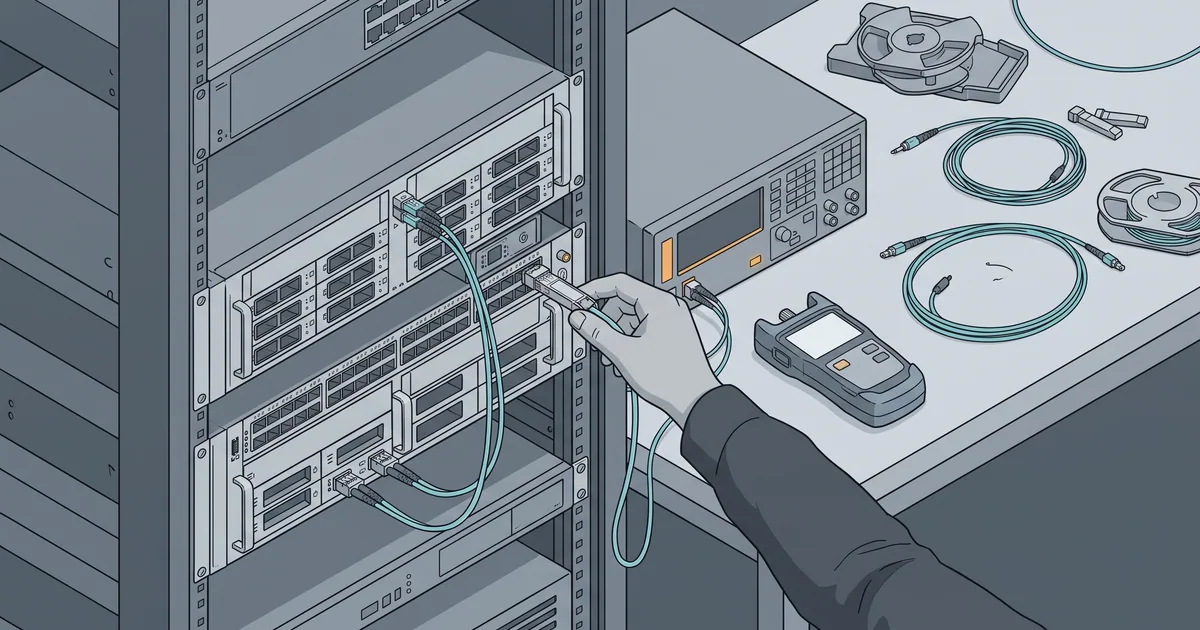
Validation of these hash distributions requires structured fiber-pull fault testing under full twenty-gigabit synthetic traffic loads. When an operator disconnects an active 10GbE optical transceiver, LACP state machines exchange Marker PDUs and transition port states within sub-second thresholds. The remaining interface immediately inherits all hash buckets, maintaining active sessions without kernel panics or buffer exhaustion. As established by late March 2012 operational standards, dual 10GbE bonds deliver true linear scalability only when hashing policies dynamically match the high-entropy tuple distribution of modern application traffic.
Sources
- InTech: Optimal Control Strategies for Multipath Routing: From Load Balancing to Bottleneck Link Management, 2012-03-30
- RFC Editor: Analysis of an Equal-Cost Multi-Path Algorithm, 2000-11-01
- IEEE: Enabling flow-based routing control in data center networks using Probe and ECMP, 2011-04-01
- IEEE: Impact of topology and link aggregation on a PC cluster with Ethernet, 2008-09-01