During January 2012, telecommunications engineers configuring edge aggregation huts and remote roadside cabinets face persistent risks of operational isolation when routing equipment misbehaves. Industry specifications for remote serial port control and telecom power distribution underscore that establishing resilient out-of-band console and power supervision across remote infrastructure is essential to prevent catastrophic loss of administrative visibility when primary transport interfaces fail. When an edge router drops its forwarding tables or halts at an interactive boot prompt, standard network-accessible management channels vanish entirely. The architectural challenge therefore centers on a vital question: How should an equipment cabinet wire serial console ports and power-cycle relays so remote recovery never depends on the router being recovered?
Why does in-band SSH management fail during boot-loader stalls or routing-table corruption?
Establishing resilient out-of-band console and power supervision across remote infrastructure is essential to prevent catastrophic loss of administrative visibility when primary transport interfaces fail. Telecom power and remote access engineering analyses indicate that preventing unneeded truck rolls to remote facilities is critical to sustaining operational viability across dispersed points of presence. Remote router administration frameworks rely on dedicated asynchronous diagnostic channels to assess operational state when local control-plane routing hangs. Decoupled physical power relays and remote terminal concentrators allow baseline supervisory signals to persist even under conditions of constrained local connectivity. Out-of-band hardware enforcement mechanisms provide fail-safe operational intervention independently of client-facing forwarding layers. Independent console and power management buses allow network operators to interrogate device states and cycle peripheral power feeds during complex node outages. In-band SSH access operates atop the very protocol stack and kernel execution context it seeks to supervise. When an operator pushes an erroneous routing policy or when corrupted BGP sessions flood memory, the router operating system often drops TCP sessions, suppresses incoming management traffic, or enters a soft lockup. Because preventing unneeded truck rolls to remote facilities is critical to sustaining operational viability, dispatching field technicians across hundreds of miles to attach a rollover cable to a frozen edge box imposes unacceptable financial and operational penalties. Consequently, remote router administration frameworks rely on separate diagnostic channels to assess operational state when local control-plane routing hangs. The vulnerability deepens during kernel panics or boot-loader cycles. When hardware encounters memory parity faults or when flash storage encounters corrupt firmware images, the processor drops into an interactive ROM monitor such as ROMMON or U-Boot. At this foundational stage, network interface cards lack initialization, dynamic IP leases do not negotiate, and cryptographic SSH daemons do not execute. Administrative access becomes physically bounded to the asynchronous RS-232 serial UART interface.
How should serial console concentrators and switched PDUs be wired across isolated power buses?
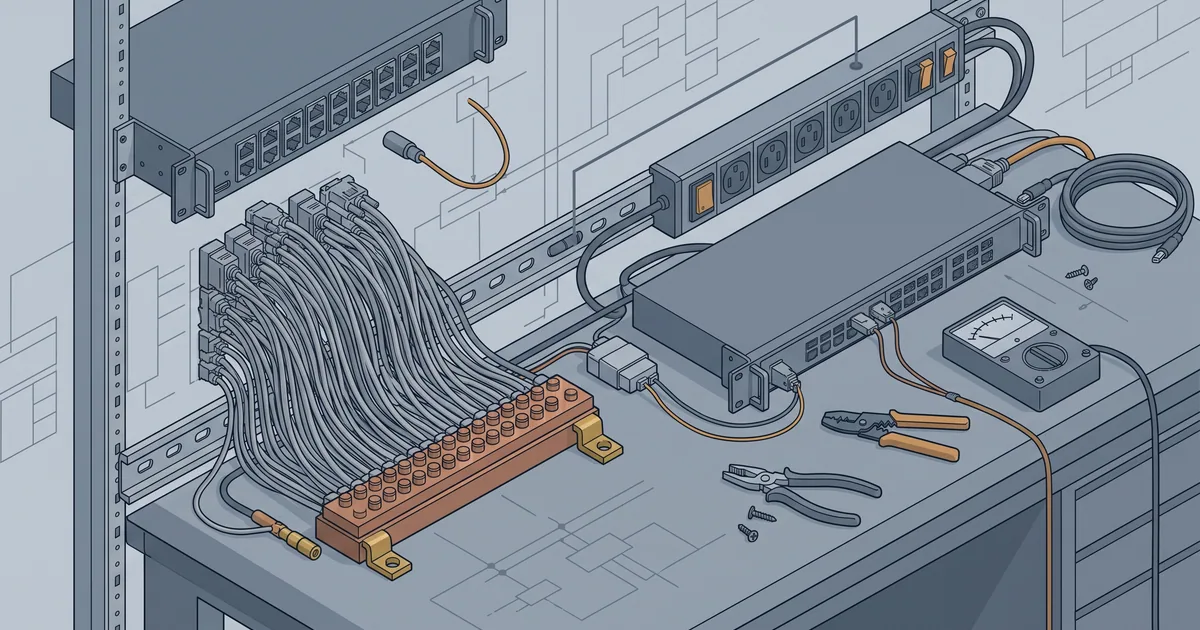
Solving this structural dependency requires segregating control planes from data planes at the physical layer. An independent serial console server supporting Telnet COM port control signaling (RFC 2217) and an intelligent switched power distribution unit (PDU) must occupy dedicated cabinet space, powered through isolated auxiliary wiring. In a typical minus 48-volt direct-current (DC) deployment, dual distribution feeds (Bus A and Bus B) enter the cabinet through independent circuit breakers. Dual-feed routers draw current from both rails using internal diode-ORing, but single-corded maintenance devices require careful distribution to prevent single-point power failures. To preserve out-of-band integrity, the serial terminal server must draw its energy from an uninterruptible primary bus, while the switched DC power relays reside on an isolated breaker branch separated from the managed routers. By connecting the serial management server to an isolated cellular modem or a secondary dial-up POTS line, network operators maintain a pristine diagnostic pathway. RS-232 cables must follow strict pinout definitions, such as Cisco RJ-45 to DB-9 rollover configurations, while avoiding shared ground loops that can induce baud-rate framing errors or false break signals during sudden voltage spikes across the chassis. Furthermore, independent console and power management frameworks allow network operators to interrogate device states and manage peripheral power nodes during complex node outages. When power relays and terminal concentrators run on distinct auxiliary DC feeds, an operator can issue a cold reboot command to a deadlocked router without terminating the terminal server session itself. The terminal server captures boot logs directly into local non-volatile ring buffers, ensuring post-mortem crash dumps remain available even if the out-of-band link momentarily drops.
What cold-start fault drills verify out-of-band recovery before a cabinet enters service?
Cold-start validation requires intentional disruption before commissioning remote sites into live production networks. Rigorous commissioning scripts simulate simultaneous fiber cuts and total control-plane kernel lockups by severing primary backhaul and pulling the primary power rail. Technicians confirm that cellular out-of-band paths remain reachable, console buffers record the full boot sequence, and relay commands execute power cycles cleanly without resetting the terminal server. As of January 2012, isolating supervisory serial wiring and DC power distribution remains the foundational discipline for autonomous, unassisted remote recovery across remote network nodes.
Sources
- RFC Editor: Telnet Com Port Control Option, 1997-10-01
- IEEE: Requirements of the power system architecture for using the next generation of smart telecom power distribution systems in combination with solid state hypride circuit breakers, 2010-06-01
- IEEE: Telecom power system design for reliability compliance, 2008-09-01
- CRC Press: Network Router Security, 2007-05-14