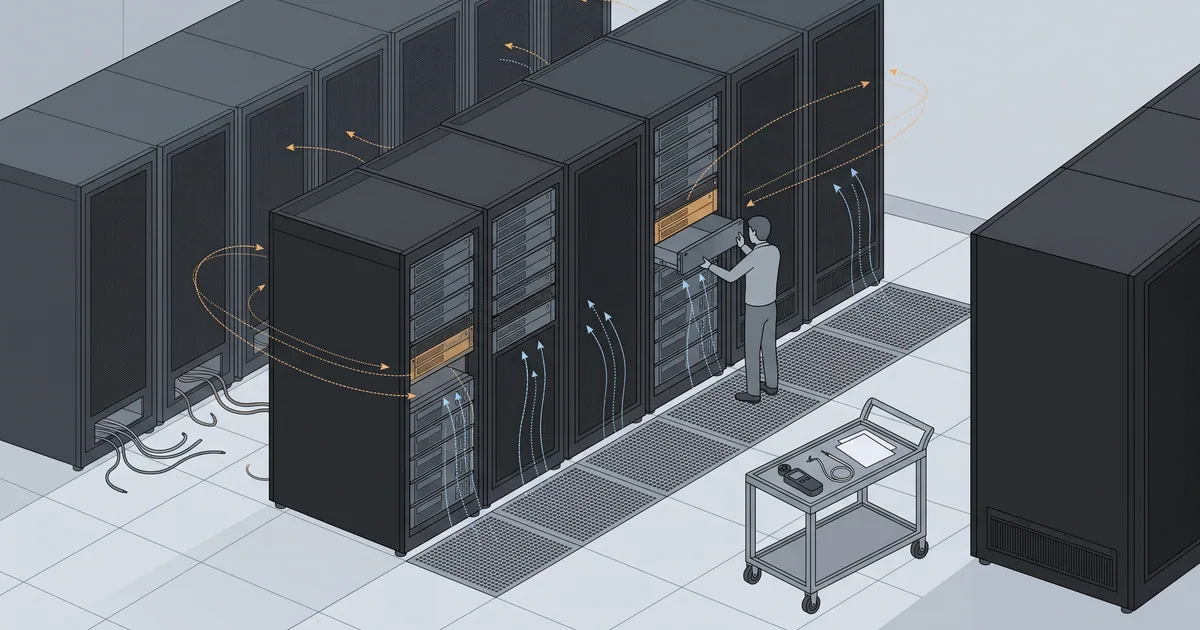
During July 2012, data center infrastructure teams confronting escalating summer heat loads face a counterintuitive thermodynamic dilemma across dense server rows. Rigorous Computational Fluid Dynamics (CFD) modeling and data center containment studies demonstrate that overall room air conditioning capacity does not dictate internal chassis thermal stability when physical airflow boundaries fail. Engineers repeatedly ramp computer room air handler (CRAH) blowers to maximum output, only to observe server processors overheating at the top of the cabinet. Why does adding more room cooling capacity fail to lower server inlet temperatures when rack airflow recirculation is left unsealed?
How do open rack units and floor cable cutouts create short-circuit exhaust recirculation loops?
CFD airflow analysis proves essential for predicting localized recirculation zones and managing containment efficiency across high-density computing infrastructure during peak summer ambient conditions. Empirical and numerical studies of enclosed-aisle data centers demonstrate that sealing bypass airflow and preventing hot-exhaust recirculation are critical to maintaining uniform server inlet temperatures and reducing cooling energy overhead. Thermal investigations of server rack population density confirm that unsealed gaps in partially populated rack enclosures allow warm exhaust to recirculate directly back to server intakes, creating steep vertical temperature gradients. Field performance evaluations of modular hot-aisle containment systems establish that physical separation between supply and exhaust air streams lowers server fan power draw and eliminates upper-rack hot spots. Maintaining positive static pressure in the cold supply plenum relative to the hot aisle prevents exhaust air from curling over cabinet tops or drawing through unblanked rack slots. Consequently, computational and empirical facility benchmarks confirm that combining rigid hot-aisle baffles, sealed raised-floor cutouts, and continuous blanking-panel discipline stabilizes rack inlet thermal profiles even under peak summer compute loads. When open spaces between chassis or unsealed raised-floor cutouts exist, the static pressure differential created by high-CFM server fans induces localized low-pressure pockets on the cold intake face. Because gaps in rack enclosures allow warm exhaust to bypass internal channels and recirculate directly back to server intakes, server chassis fans generate a closed pneumatic loop whenever unoccupied rack units remain unshielded. Without 1U and 2U blanking panels, the 45-degree-Celsius air discharge from rear chassis exhausts curls directly over the top of the cabinet and through vacant mounting slots. Because air follows the path of least pneumatic resistance, the high-temperature exhaust mixes with conditioned supply air right at the server bezel. Flooding the room with colder air from perimeter CRAH units cannot break this short-circuit vortex because internal server fans immediately ingest the nearest low-resistance volume. Simultaneously, unsealed cable cutouts beneath the rear rack plinth bleed up to thirty percent of pressurized subfloor cold air directly into the hot aisle, starving perforated cold-aisle floor tiles of static pressure and starving top-of-rack equipment of cool supply air.
Why does sealing hot-aisle boundaries lower fan power draw while stabilizing top-of-rack inlet temperatures?
In uncontained environments, server baseboard management controllers (BMCs) detect elevated inlet temperatures via front-bezel thermistors and command pulse-width modulation (PWM) fan controllers to ramp toward maximum rotational velocity. By the affinity laws of turbomachinery, fan electrical power consumption scales with the cube of rotational speed, introducing a severe parasitic power penalty across every chassis in the row while further accelerating exhaust recirculation. Sealing the hot-aisle boundary through rigid end-of-row doors, overhead plenum baffles, and brush-grommet cable seals isolates the hot exhaust plume from the room, channeling waste heat directly back to the CRAH return coils. When hot-aisle containment and full blanking-panel discipline are enforced, server exhaust cannot spill backward over the top rack units or through empty mid-rack bays. The resulting pressure stabilization eliminates the localized thermal stratification that routinely pushes top-of-rack 10GbE switches and upper blade chassis past ASHRAE recommended 27-degree-Celsius inlet envelopes. Because the intake air temperature stabilizes near the supply temperature delivered through the perforated floor tiles, internal chassis PID fan controllers throttle blower speeds back down to baseline operating rates, trimming both server parasitic kilowatt draw and CRAH blower energy.
How should thermistor arrays be placed to profile vertical temperature gradients across a loaded cabinet?
To maintain thermal integrity and verify containment compliance as of July 31, 2012, data center instrumentation standards prescribe installing calibrated thermistor strings at three distinct vertical elevations along the front server intake plane: bottom (rack units 4 to 6), middle (rack units 20 to 22), and top (rack units 38 to 40). A vertical temperature delta exceeding two degrees Celsius between bottom and top intake sensors immediately exposes missing blanking panels, torn brush grommets, or insufficient subfloor static pressure. By coupling continuous physical baffle maintenance with three-point vertical sensor profiling, facilities achieve uniform inlet cooling without wasting energy on over-chilled room air.
Sources
- University of Texas at Arlington (UTA ResearchCommons): CFD Analysis Of Direct Evaporative Cooling Zone Of Air-side Economizer For Containerized Data Center, 2012-07-25
- ASME International: Optimization of Enclosed Aisle Data Centers Using Bypass Recirculation, 2012-06-01
- IEEE: Effect of rack server population on temperatures in data centers, 2012-05-01
- Office of Scientific and Technical Information (OSTI): Performance Evaluation for Modular, Scalable Cooling Systems with Hot Aisle Containment in Data Centers, 2009-05-01