During February 2012, fixed wireless broadband operators and outdoor network architects face mounting spectral congestion across unlicensed and lightly licensed 5 GHz bands. Field propagation studies and fixed wireless access models demonstrate that optimizing link capacity and spectral efficiency under physical propagation limits requires stringent Fresnel zone clearance and antenna isolation. Field teams frequently confront a counterintuitive pathology during tower turn-ups: links exhibiting high received signal strength indicators nevertheless register severe transmission failure rates. Why does a wireless link with strong received signal strength still suffer packet retries when Fresnel clearance or adjacent-sector isolation is compromised?
How do partial Fresnel-zone obstructions and reflections degrade dual-polarity MIMO chains?
Evaluating Fresnel-zone clearance and two-ray multipath propagation across fixed wireless links is critical in February 2012 to determine real-world channel capacity and path loss exponents under physical terrain constraints. Characterizing fixed wireless access channels with ray-tracing and Fresnel-zone models is vital for predicting diffraction and reflection impairments across obstructed outdoor topologies. Wireless network throughput and modulation stability degrade significantly when partial Fresnel-zone obstructions and multipath reflections disrupt orthogonal spatial streams. Maintaining high cross-polarization discrimination on dual-polarized base station antennas mitigates mutual interference across dual-chain MIMO channels. Calibrating mechanical antenna downtilt and sector isolation suppresses co-channel interference and improves multi-antenna link reliability across shared towers. Ultimately, outdoor MIMO performance and spectral efficiency are bounded by cross-polarization isolation, Fresnel clearance, and inter-sector interference dynamics. Dual-polarity multiple-input multiple-output (MIMO) architectures in the 5 GHz band depend directly on orthogonal spatial paths between horizontal and vertical antenna arrays. When terrain obstacles, tree canopies, or rooftops encroach upon the primary Fresnel zone, diffraction induces phase shifts and multipath propagation delays. Characterizing these fixed wireless links is critical because Fresnel-zone diffraction and surface reflections rapidly degrade signal quality across outdoor point-to-multipoint sectors. Multipath interference destroys the spatial independence required by 802.11n baseband decoders, causing cross-polarization discrimination to collapse despite strong aggregate radio frequency energy. This baseband degradation directly affects the medium access control layer. When out-of-phase reflections strike the receiver, the radio reports a high signal strength value derived from the raw root-mean-square amplitude across the 20 MHz or 40 MHz channel, masking severe destructive phase cancellation at individual subcarriers. Because local multipath channel impairments disrupt end-to-end symbol delivery, orthogonal frequency-division multiplexing pilot subcarriers fail symbol recovery, prompting cyclical parity errors. The rate-adaptation state machine then rapidly steps down modulation from 64-QAM to QPSK or BPSK, triggering repetitive layer-2 retransmissions even though standard administrative telemetry reports abundant power margin.
Why must mechanical antenna downtilt and front-to-back shielding be calibrated per sector?
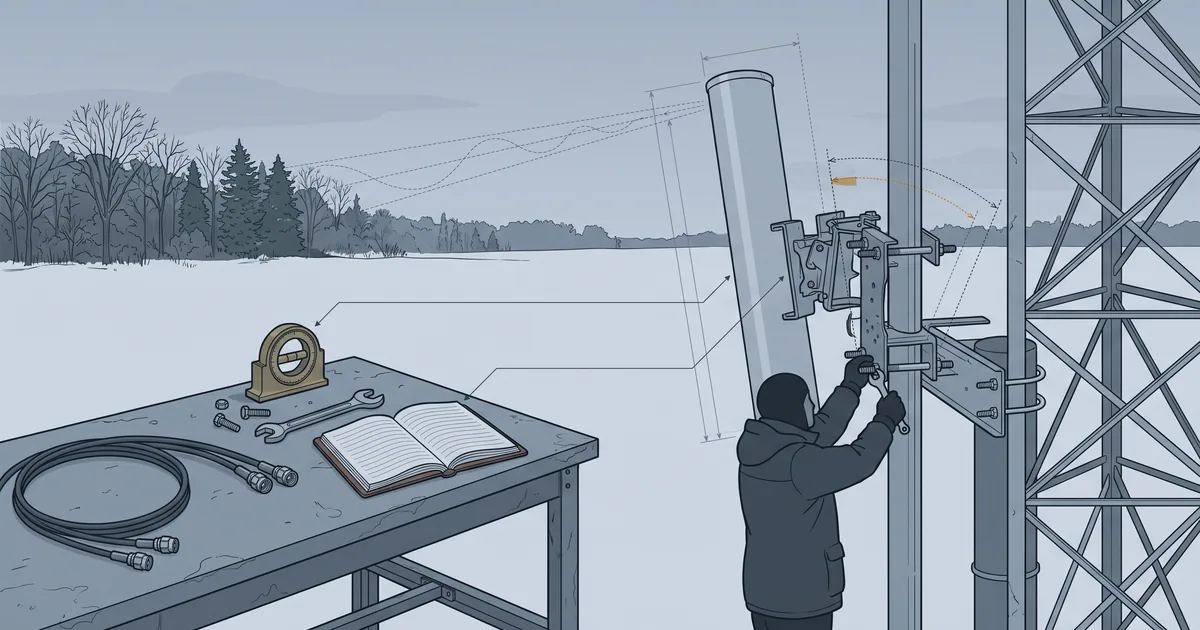
Sectorized co-location on multi-panel broadcast towers creates severe self-interference without rigorous physical isolation and downtilt geometry. Co-channel and adjacent-channel energy bleeding into backward lobes raises local noise floors, blinding receiver front-end low-noise amplifiers during scheduled reception windows. To manage this congestion, network engineers apply rigorous antenna isolation and polarization discipline: maintaining high cross-polarization discrimination and sector partitioning mitigates mutual interference across multi-antenna channels. Tower operators enforce strict containment between real-time data payloads and administrative control sessions, isolating management traffic into protected virtual local area networks to prevent control timeouts when payload airtime experiences packet retry storms. Physical sector design requires mechanical downtilt adjustments matched precisely to beam elevation patterns and client cluster distributions. Relying solely on electrical tilt or excessive transmit power illuminates distant structures, multiplying secondary scatter and elevating the tower site's cumulative noise floor. Furthermore, propagation studies confirm that coordinating antenna downtilt across multi-antenna sectors suppresses inter-sector interference and improves link reliability at cell edges. In commercial deployments, outdoor MIMO performance and spectral efficiency remain bounded by cross-polarization isolation and inter-sector interference dynamics. Front-to-back isolation shields, metallic shrouding, and distinct physical separation between sector panels prevent side-lobe coupling, ensuring local receiver circuits retain high dynamic range. Operational containment policies require systematic pre-deployment calibration to isolate co-channel sectors before assigning customer traffic.
What baseline spectrum and modulation tests confirm link margin before adding subscriber units?
Establishing reliable 5 GHz fixed infrastructure as of February 29, 2012, requires validating signal quality beyond gross received power indicators. Technicians must conduct baseline spectrum scans during busy hours, verify sixty percent clearance of the first Fresnel zone, and benchmark error vector magnitude across both horizontal and vertical polarization chains. Confirming thirty decibels of signal-to-noise margin at the highest modulation profiles before provisioning customer equipment protects system capacity, preserves airtime, and ensures network stability under rigorous production traffic.
Sources
- IEEE: Analysis of the Relation Between Fresnel Zone and Path Loss Exponent Based on Two-Ray Model, 2012-01-01
- IEEE: Incorporating the Fresnel Zone Theory in Ray Tracing for Propagation Modelling of Fixed Wireless Access Channels, 2007-09-01
- IEEE: Influence of cross-polarization characteristics on indoor MIMO performance using a dual-polarized base station antenna, 2010-07-01
- Sociedade Brasileira de Telecomunicações: Interference management and antenna downtilt in multi-antenna CoMP systems, 2012-01-01