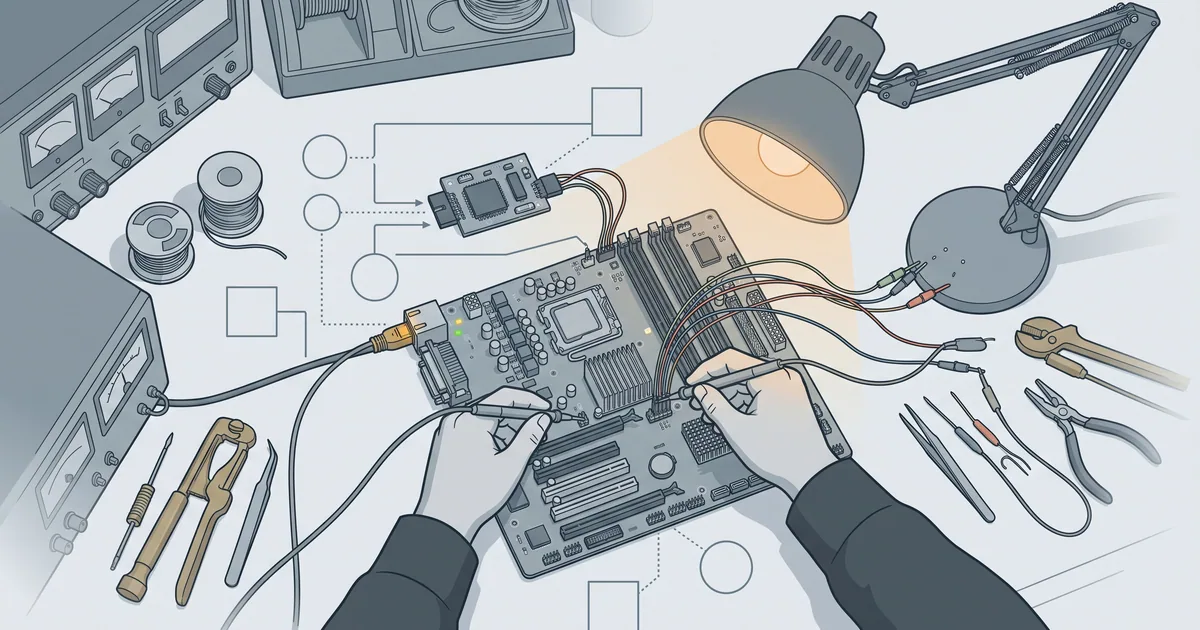
During September 2012, systems engineers deploying mission-critical network appliances at unmanned points of presence faced an acute operational dilemma when remote servers became unresponsive during silent kernel lockups. Hardware reliability and platform management studies demonstrate that dedicated supervisory watchdog circuits and isolated Baseboard Management Controllers (BMCs) are essential to detect processor hangs and execute hard electrical resets when host operating system execution halts. However, when unrecoverable panics freeze kernel interrupt handlers entirely, conventional software-level supervision fails while public exposure of management ports invites severe security risk. This reality forces engineers to answer a vital operational question: How can an unattended remote appliance recover automatically from a kernel hang without exposing its baseboard management controller to the public network?
Why do software-only health checks fail when a kernel panic locks the interrupt handler?
Hardware reliability studies demonstrate that independent watchdog timer circuits are essential to detect processor lockups and trigger autonomous system resets when soft errors or kernel faults halt normal instruction execution. Intelligent Platform Management Interface (IPMI) specifications establish an independent Baseboard Management Controller (BMC) subsystem powered by standby rails so system health monitoring and power control operate completely outside the host CPU and operating system. Hardware implementations of intelligent platform management controllers confirm that dedicated microcontroller supervision over I2C and IPMB buses enables reliable cold-reset sequencing and environmental fault isolation when host processors hang. Embedded firmware engineering principles further emphasize that an effective watchdog design must couple an external hardware counter to multi-task application health verification rather than relying on a simple timer-interrupt service routine. Consequently, isolating baseboard management network interfaces onto air-gapped or strictly firewalled out-of-band VLANs while relying on local hardware watchdogs for autonomous crash recovery prevents remote appliances from exposing vulnerable BMC ports to the public internet. Software-only health checks inherently rely on the host operating system scheduler, memory allocator, and peripheral interrupt subsystems remaining operational. When a kernel panic, uncorrectable PCIe bus lockup, or spinlock deadlock occurs with interrupts disabled, internal CPU timer ticks cease scheduling userland processes. Under these catastrophic conditions, monitoring scripts executed via `cron` or userland supervisory daemons cannot transmit diagnostic alerts or invoke a clean `/sbin/reboot` syscall. Even a naive kernel-level watchdog thread that pets a timer inside a hardware interrupt handler can continue firing while userland routing daemons (`bgpd` or `ospfd`) are completely deadlocked in uninterruptible disk sleep (`D` state). If a kernel panic simultaneously freezes the network interface driver ring buffers, remote administrative access via in-band SSH vanishes, leaving the remote appliance stranded until a technician physically cycles power on-site.
How should hardware watchdog timers be coupled to multi-stage application health probes?
To build a resilient autonomous recovery pipeline, systems architects decouple application health verification from hardware timer strobing across a strict userland-to-hardware interface boundary. Rather than letting a blind kernel timer reset the countdown register, a userland watchdog daemon (`/dev/watchdog`) executes synthetic end-to-end liveness checks before issuing each `WDIOC_KEEPALIVE` ioctl call to the motherboard Super I/O, Intel TCO, or IPMI BMC watchdog timer. In each polling cycle, the supervisor verifies that the system load average is bounded, critical file systems remain writable, packet forwarding tables are populated, and local routing daemons respond on their control sockets. If any application-layer probe hangs or fails across consecutive intervals, the daemon deliberately ceases writing to `/dev/watchdog`, allowing the independent hardware countdown register to expire. Coupling the hardware watchdog timer to multi-stage health probes requires careful timeout hysteresis to prevent reboot loops during legitimate boot-time fsck runs or transient BGP table convergence spikes. Engineers therefore configure a two-stage timeout hierarchy: a pre-timeout warning interrupt (such as an IPMI watchdog pre-timeout NMI at 45 seconds) triggers a kernel crash dump (`kdump`) and logs the instruction pointer to persistent serial or BMC System Event Log (SEL) storage, followed at 60 seconds by a hard electrical reset asserted directly against the motherboard cold-reset pin or power-supply `PS_ON#` line. Cycling primary board rails guarantees that latched PCIe bridges, hung DMA engines, and corrupted volatile registers return to a clean power-on reset state.
Why must baseboard management controllers reside on an isolated management network with strict firewall rules?
While IPMI 2.0 and onboard BMCs provide indispensable out-of-band power control and Serial-over-LAN (SOL) console redirection, their dedicated network interfaces run lightweight embedded firmware stacks that bypass host operating system firewalls entirely. Exposing UDP port 623 (RMCP/RMCP+) or BMC web interfaces to public or subscriber-facing VLANs exposes the appliance to cipher-zero authentication bypasses, hash extraction, and total chassis takeover. As of September 30, 2012, hardened deployment standards mandate binding BMC network ports exclusively to air-gapped management VLANs reachable only through authenticated jump hosts or VPN concentrators, while delegating immediate 60-second crash recovery to the local hardware watchdog timer.
Sources
- IEEE: An Improved Watchdog Timer to Enhance Imaging System Reliability In The Presence Of Soft Errors, 2007-12-01
- Springer: Intelligent Platform Management Interface, 2006-01-01
- IEEE: Intelligent Platform-Management Controller for Low-Level RF Control System ATCA Carrier Board, 2011-08-01
- Elsevier: Building a Great Watchdog, 2004-01-01