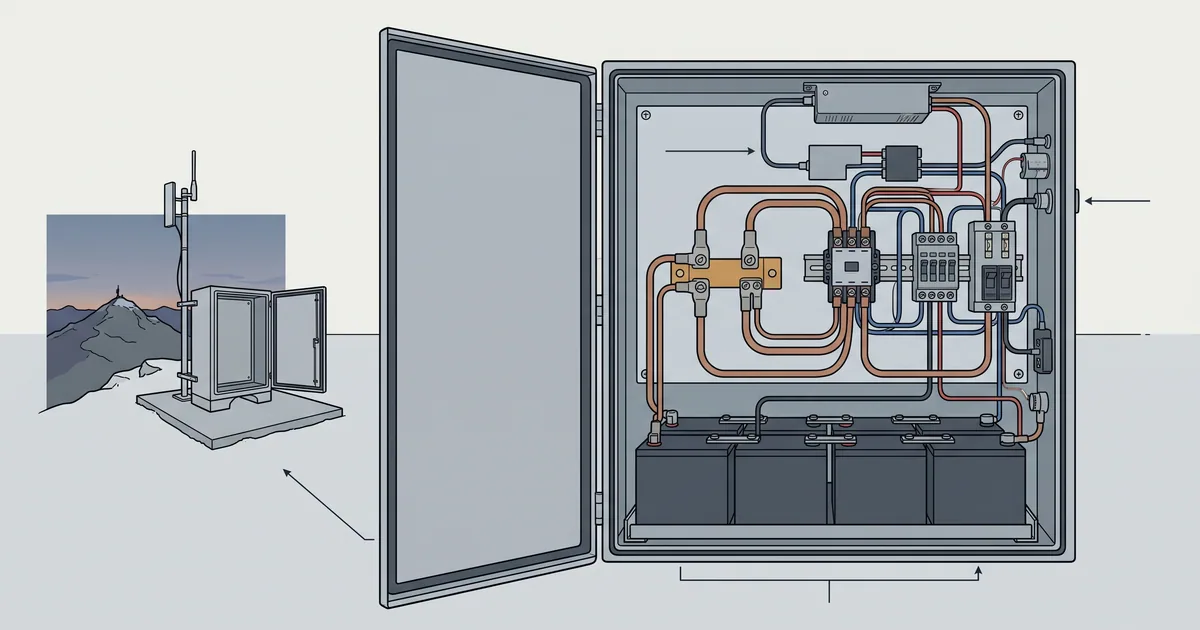
During August 2012, field engineers maintaining mountain-top wireless internet and radio relay stations face mounting operational pressure as autumn and winter weather approaches. Engineering studies of autonomous photovoltaic power plants for telecommunication relay stations underscore that accurate solar array and battery bank sizing is essential where power interruptions directly compromise continuous data transmission in isolated locations. When persistent winter cloud cover depresses solar production, undersized storage banks suffer irreversible deep-discharge sulfation. This reality forces a foundational question: How should an off-grid wireless relay site size its solar array and battery bank so winter cloud cover never permanently damages storage cells?
How do continuous DC load audits and winter insolation minimums govern battery amp-hour sizing?
Engineering analyses of autonomous photovoltaic power plants for telecommunication relay stations demonstrate that sizing solar arrays and lead-acid battery banks against worst-case winter insolation and multi-day autonomy requirements is essential for uninterrupted remote operation. Developing systematic scheduling and state-of-charge management strategies for off-grid battery systems proved vital in August 2012 to prevent destructive over-discharge conditions and optimize power supply reliability in standalone networks. Performance evaluations of standalone solar photovoltaic systems with maximum power point tracking (MPPT) and battery backup confirm that dynamic charge regulation maximizes energy harvest during low-irradiance winter conditions while preventing DC bus instability. Furthermore, standalone photovoltaic battery charge controller studies show that temperature-compensated multi-stage charging and staged low-voltage disconnect (LVD) thresholds protect valve-regulated lead-acid cells from irreversible sulfation and capacity loss. Designing an autonomous relay station begins with an unforgiving 24-hour direct-current energy audit. Field radios, microwave backhaul transceivers, network switches, and supervisory microcontrollers consume constant baseline wattage regardless of external conditions. In August 2012, engineering practice dictates calculating total daily consumption in watt-hours based on worst-case transmitter duty cycles. Valve-regulated lead-acid (VRLA) absorbed glass mat (AGM) cells offer low internal resistance and spill-proof cold-weather resilience, but withdrawing more than fifty percent of their rated amp-hour capacity dramatically curtails cycle life. Developing systematic state-of-charge protection for off-grid battery systems is therefore critical to prevent destructive over-discharge during multi-day storms. To guarantee survivability during December and January, sizing calculations must rely on local December minimum peak sun hours rather than annual averages, derating battery capacity by an additional twenty percent for sub-freezing electrolyte temperatures. A relay site drawing 50 continuous watts at 24 volts DC consumes 1,200 watt-hours (50 amp-hours) daily. If local meteorological records indicate a minimum winter insolation of 1.8 peak sun hours and an autonomy requirement of five consecutive sunless days, the AGM bank must provide at least 500 amp-hours at 24 volts (12,000 watt-hours nominal) to enforce a strict fifty percent depth-of-discharge ceiling.
Why must MPPT solar charge controllers be filtered and shielded near sensitive VHF and microwave receivers?
Maximum power point tracking (MPPT) controllers extract twenty to thirty percent more winter energy from cold, high-voltage photovoltaic strings than legacy pulse-width modulation (PWM) shunt regulators by stepping higher array voltages down to battery charging potential. However, their high-frequency DC-DC buck converters switch at tens of kilohertz, generating sharp current edges (di/dt) and broadband electromagnetic interference (EMI) capable of desensitizing co-located VHF, UHF, and licensed microwave receivers. To protect weak-signal receiver noise floors, the solar conversion stage must be housed inside a bonded metallic enclosure, with toroidal common-mode ferrite chokes and differential pi-network LC filters installed on both the photovoltaic array input leads and the DC battery distribution bus. Beyond RF noise suppression, standalone MPPT charge controllers must damp voltage ripple and regulate bulk, absorption, and float stages using remote battery-post temperature sensors. Because lead-acid electrochemistry exhibits an inverse temperature coefficient of roughly minus 3 to minus 5 millivolts per degree Celsius per 2-volt cell, charging a frozen AGM bank at summer voltage setpoints starves the plates of full recharge, whereas failing to lower float voltage during summer heat drives thermal runaway and grid corrosion.
How do staged low-voltage disconnect relays shed secondary links while keeping core telemetry alive?
To guarantee site preservation through prolonged blizzards that exceed the five-day design autonomy window, resilient relay stations deploy tiered low-voltage disconnect (LVD) contactors with wide reconnect hysteresis. Rather than executing a single catastrophic total shutdown, solid-state or latching magnetic relays shed high-wattage secondary loads, such as auxiliary PTZ cameras and secondary subscriber sector radios, when the 24-volt AGM bus sags to 23.8 volts (11.9 volts per 12V monoblock). Core backhaul routing and low-power supervisory telemetry remain powered down to a hard survival cutoff of 23.0 volts (11.5 volts per 12V monoblock), preserving cell chemistry until solar irradiance returns and battery voltage recovers above 25.6 volts before re-engaging load relays. As demonstrated across field architectures as of August 2012, combining conservative winter insolation math, RF-filtered MPPT regulation, and staged load shedding safeguards autonomous mountain-top repeaters through the harshest winter seasons.
Sources
- Institution of Engineering and Technology (IET): Design of autonomous photovoltaic power plant for telecommunication relay station, 2005-01-01
- IEEE: Evolutionary algorithm based optimal scheduling of wind/diesel/battery based off grid system, 2012-08-08
- IEEE: Performance evaluation of solar photovoltaic system using maximum power tracking algorithm with battery backup, 2012-05-01
- IEEE: A simplified battery charge controller for safety and increased utilization in standalone PV applications, 2011-06-01