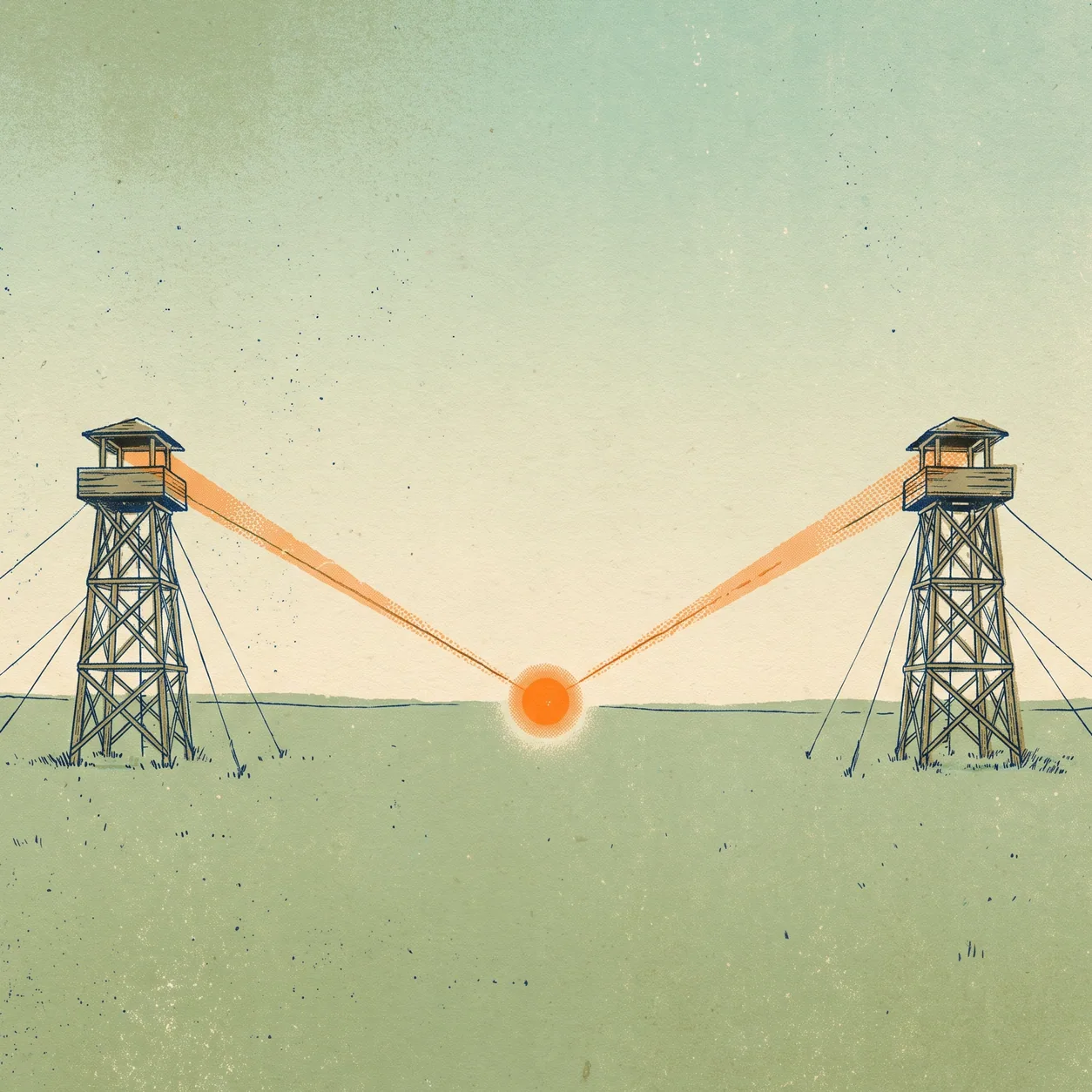
Searching for a faint signal in a massive system requires structural redundancy. Relying on a single sensor or a single team leaves room for systemic bias, whereas independent, parallel efforts provide the necessary friction to validate elusive truths.
Designing for Disagreement
Wikipedia's current-events log for December 13, 2011, recorded that according to researchers, indications of the Higgs boson may have been detected in two separate experiments carried out at the Large Hadron Collider at CERN. In a seminar held at CERN, the ATLAS and CMS experiments presented the status of their searches.
CERN's main conclusion was that the Standard Model Higgs boson, if it exists, is most likely to have a mass constrained to the range 116-130 GeV by the ATLAS experiment, and 115-127 GeV by CMS.
Parallel Processing for Human Judgment
In general, two experiments working on the same question can act as a check on each other. When building complex architectures, creating two distinct paths to test the same hypothesis prevents a single methodology from confirming its own flaws. Separate experiments may help ensure that a potential signal is examined in more than one way.
In systems engineering and product development, a single point of measurement often creates a single point of failure in decision making. Operating independent teams or instruments against the same problem space requires more resources upfront, but it dramatically reduces the risk of false positives. The value lies in the overlap of independent results. If two separate frameworks were to return similar indications, the chance of a shared error might fall.
Designing for certainty means designing for disagreement. If two systems cannot independently arrive at the same conclusion, the underlying premise remains unproven. This principle extends beyond particle physics into any discipline requiring rigorous human judgment. Whether evaluating a new market, testing a software prototype, or analyzing user behavior, relying on a single data stream invites confirmation bias.
True validation comes not from a single loud signal, but from the quiet agreement of isolated systems.
Sources
- Portal:Current events/2011 December 13 (revision 466276298) - Wikipedia, 2011-12-17T05:12:56Z
- CERN Press Release - CERN Press Office, 2011-12-13