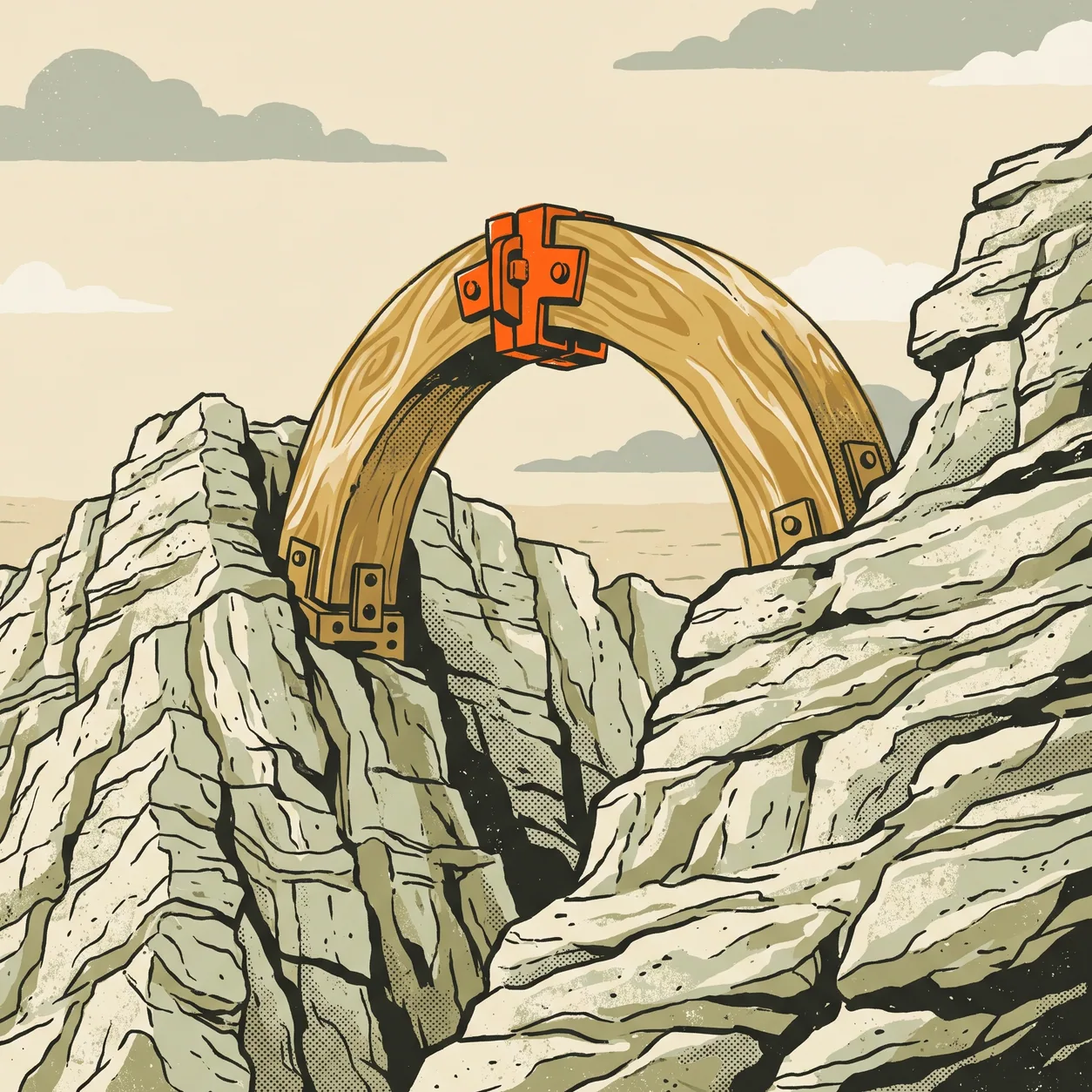
Designing physical parts for highly constrained or irregular environments can require shifting from mass standardization to customized fabrication. When structural integrity and complex geometry must coexist, bespoke digital manufacturing may offer functional options that standardized components cannot match. This approach can allow engineers to tailor physical solutions precisely to unique environmental requirements rather than adjusting the environment to fit off-the-shelf components.
CSIRO reported that a Spanish cancer patient received a 3D printed titanium sternum and rib implant that was designed and manufactured in Melbourne. CSIRO stated that the Spanish cancer patient's surgical team from Salamanca University Hospital determined that a fully customisable 3D printed sternum and rib cage was the best option. Wikipedia's current-events log recorded that doctors at Salamanca University Hospital in Salamanca, Spain implanted a 3-D printing-produced artificial titanium sternum. CSIRO added that twelve days after the surgery the patient was discharged and has recovered well.
Why Custom Component Fabrication Might Change Complex Systems
In traditional hardware and mechanical engineering, standardized off-the-shelf components are often chosen for production speed and established manufacturing processes. However, rigid standard components might introduce trade-offs or point-of-failure risks when forced into complex, highly specific assemblies. A customized digital fabrication workflow could potentially eliminate unnecessary spatial compromises by producing an exact structural fit directly from high-resolution geometric inputs. By bridging the gap between digital modeling and physical creation, custom production pipelines may allow teams to address unique design constraints that off-the-shelf solutions might struggle to satisfy. Furthermore, shifting from uniform mass production toward adaptive digital techniques could alter how teams evaluate design tradeoffs.
How Precision Manufacturing Could Influence Future Engineering
When physical systems demand both long-term stability and high adaptability under tight constraints, bespoke digital fabrication could become a vital approach for technical teams. Product builders who carefully evaluate individual operational demands early in the design phase might find that custom-manufactured hardware can simplify overall system architecture. Rather than relying on generic designs that could require extensive downstream modification, tailored production methods might offer cleaner integration paths. Evaluating bespoke options upfront may also help engineering teams reduce unpredictable fit issues later in the lifecycle. Ultimately, the choice between off-the-shelf standardized parts and bespoke digital structures may depend on whether custom front-end precision creates greater overall system reliability.
Sources
- Cancer patient receives 3D printed ribs in world first surgery - CSIRO - CSIRO, 2015-09-11
- Portal:Current events/2015 September 13 (revision 681514032) - Wikipedia, 2015-09-17