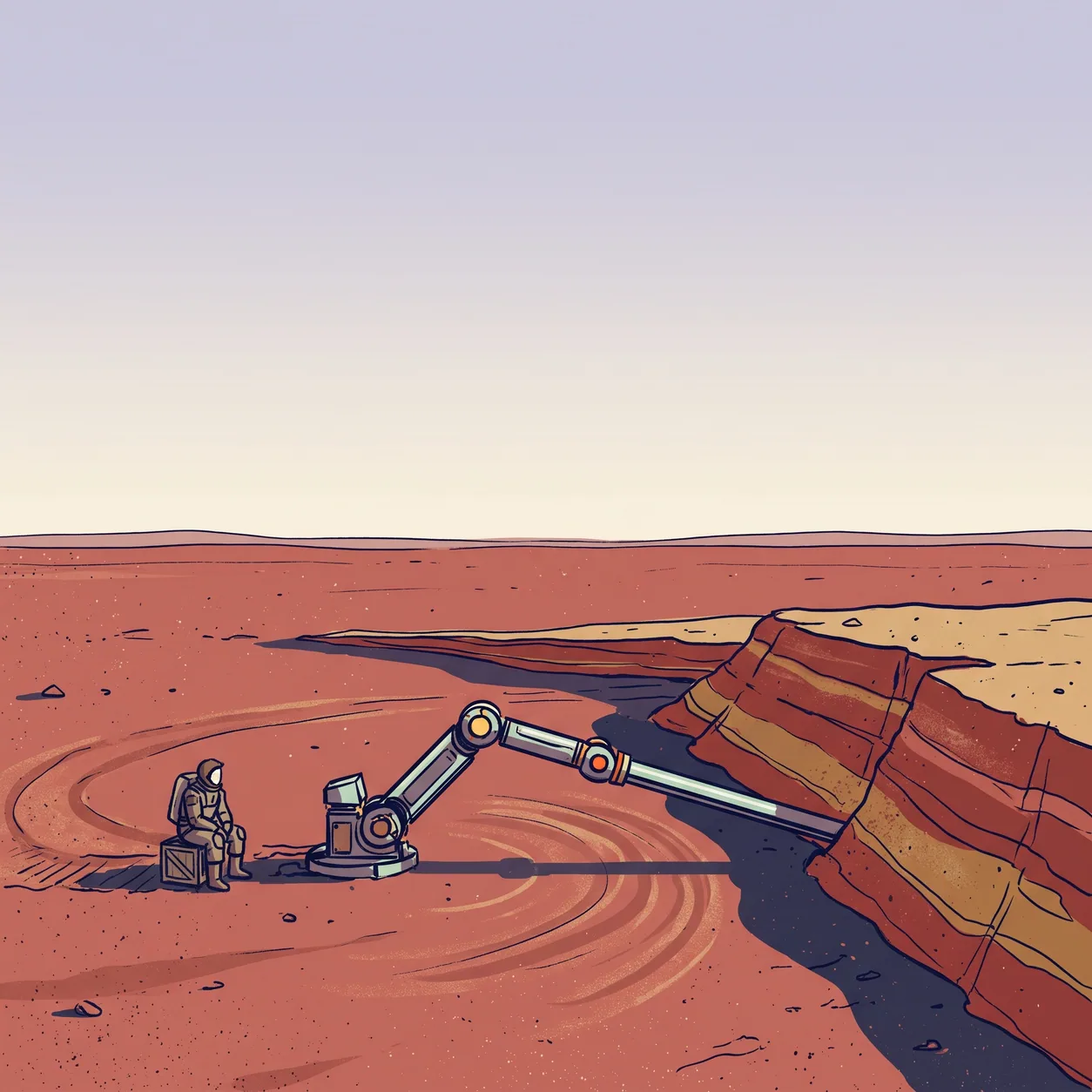
Unexpected physical conditions might easily halt hardware operating in remote environments. When forward progress stalls unexpectedly, observers could instinctively assume that an immovable obstruction blocks the path, even though a subtle environmental mismatch might be the true root cause. Developing solutions in unfamiliar terrain can require patience, iterative testing, and a willingness to question original operational models.
How Remote Hardware Might Adapt to Mismatched Environments
Wikipedia's current-events log for October 17, 2019 recorded that NASA announced that the InSight Mars lander's heat probe had successfully dug 3 cm into the ground after becoming stuck 35 cm in the ground in February 2019. Wikipedia's current-events log for October 17, 2019 recorded that the InSight lander landed near the Martian equator in November 2018. NASA Jet Propulsion Laboratory reported that InSight's heat probe, known as the mole, has only managed to partially bury itself since it started hammering in February 2019. NASA Jet Propulsion Laboratory reported that since Oct. 8, 2019, the heat probe has hammered 220 times over three separate occasions. HP 3 Principal Investigator Tilman Spohn of DLR stated that seeing the mole's progress seems to indicate that there is no rock blocking their path.
What Complex Projects Could Learn From Unplanned Stalls
When an automated or mechanical system experiences a prolonged halt, engineering teams might face pressure to declare a total failure. However, jumping to dramatic conclusions could obscure simpler explanations, such as a localized lack of resistance or altered surface dynamics. System operators might benefit from testing gentle procedural adjustments before deciding to abandon a costly mission asset.
Isolating the source of resistance can often be an iterative exercise. By methodically adjusting how pressure or force is applied, project teams might gradually uncover new ways to bypass environmental friction. Rather than forcing a system through brute mechanical effort, carefully calibrated changes could provide the necessary grip to restore continuous execution.
In high-stakes technical projects, methodical diagnostics can perhaps prove as essential as the primary engineering design. An apparent physical dead end might merely reflect an incomplete understanding of surrounding conditions. Challenging working assumptions and attempting alternative maneuvers can potentially turn a long-standing operational standstill into renewed progress.
Sources
- Portal:Current events/2019 October 17 (revision 922670430) - Wikipedia, 2019-10-23
- News | Mars InSight's 'Mole' Is Moving Again - NASA Jet Propulsion Laboratory, 2019-10-17