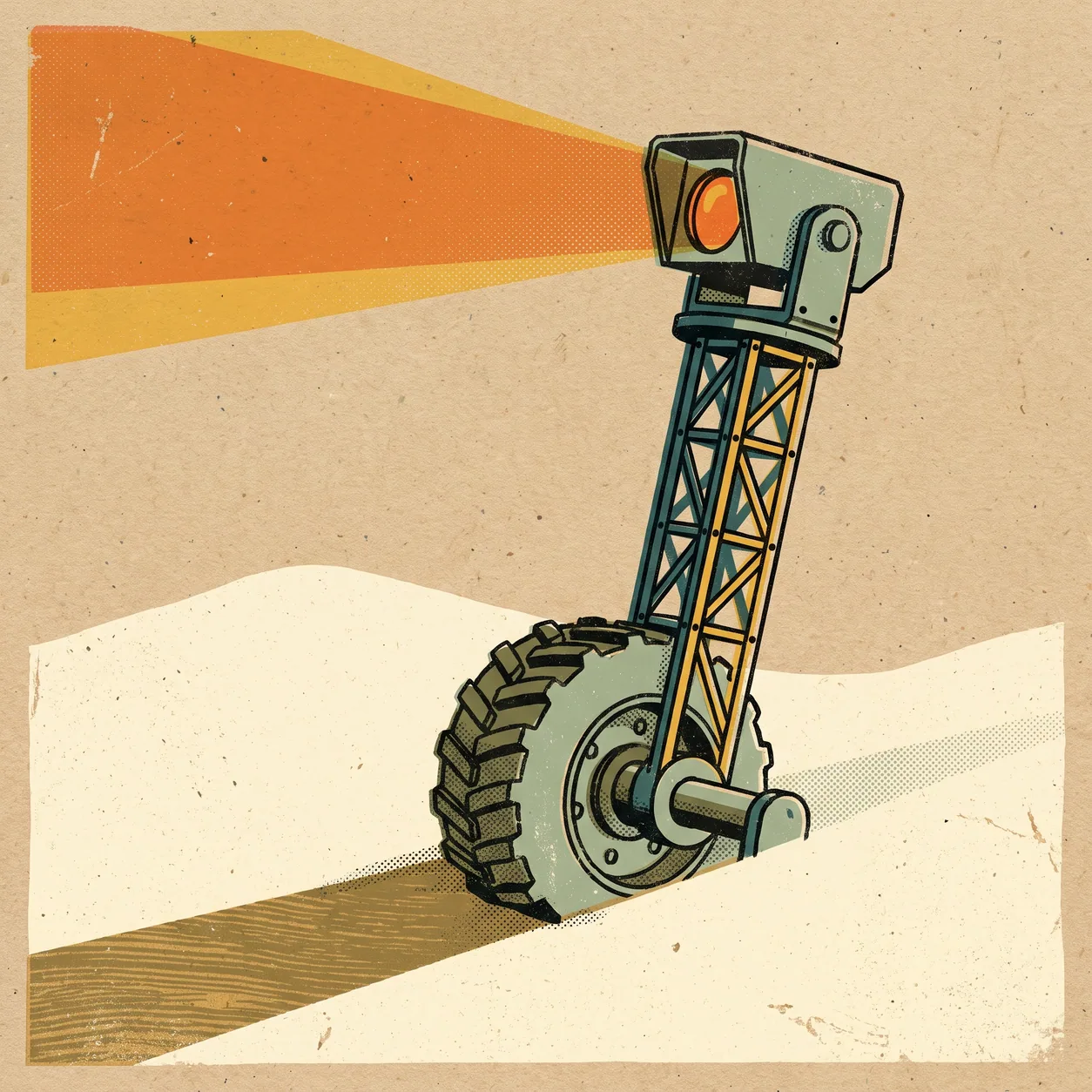
Hardware failures often dictate the end of a remote deployment. Yet, a system's utility can persist if its operators adapt its mission to match its new physical constraints. Engineering a machine for a specific environment involves assumptions that reality will eventually challenge.
Spirit and Opportunity landed on Mars in January 2004. The Spirit, designed to last three months, has survived for more than six years. According to the Times, the previous March the Spirit’s six wheels broke through a hard crust into sandy material and became stuck.
Redefining Operational Success
Wikipedia's current-events log recorded that NASA and Cornell University have given up attempting to move the Spirit rover. NASA has designated the once-roving scientific explorer a stationary science platform after efforts during the past several months to free it from a sand trap. Its twin rover, Opportunity, remains mobile on Mars.
When a mobile unit loses its primary mode of transit, the remaining functional components might still operate perfectly. A design constraint does not always represent the absolute limit of a machine's operational life. By accepting the loss of mobility rather than exhausting resources to restore it, operators can shift their focus to the capabilities that remain intact.
This transition illustrates how rigid hardware can be managed with flexible operational parameters. A stranded vehicle does not necessarily become debris; it can serve a completely different function as a fixed outpost. True resilience involves recognizing when to stop fighting an irreversible mechanical failure and start utilizing the system's new reality. A change in status may not be a failure, but an evolution of purpose.
Sources
- Portal:Current events/2010 February 3 (revision 343430740) - Wikipedia, 2010-02-11.
- NASA - Now a Stationary Research Platform, NASA's Mars Rover Spirit Starts a New Chapter in Red Planet Scientific Studies - NASA, 2010-01-26.
- Stuck in Sand, Mars Probe Will No Longer Rove - NYTimes.com - The New York Times, 2010-01-26.