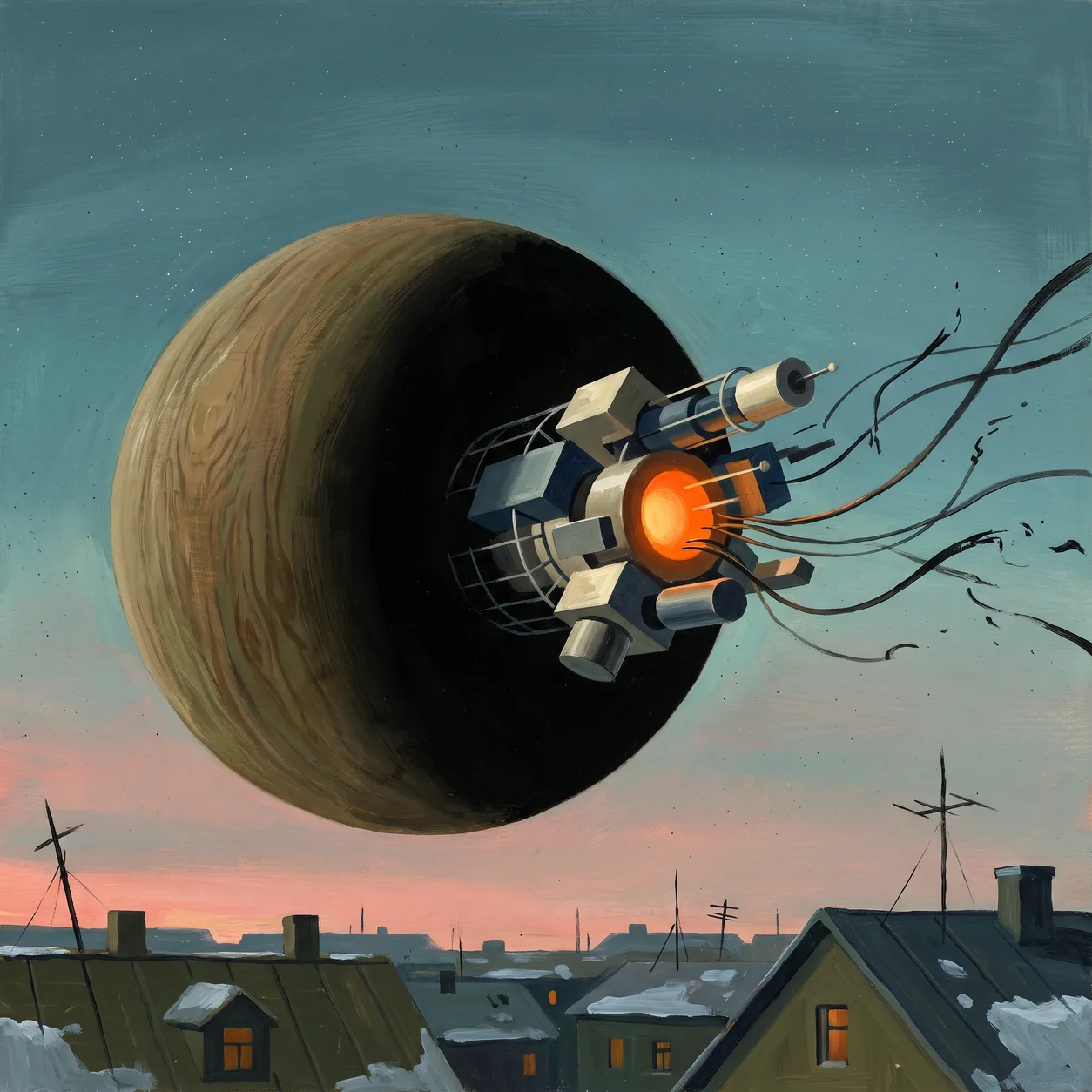
Complex automation is ultimately tested not when operators are watching, but when they are entirely locked out. True system resilience requires designing for periods of absolute blindness.
On March 10, 2006, the Mars Reconnaissance Orbiter entered orbit around Mars. To achieve capture by the planet's gravity, the spacecraft fired its six main engines at 4:24 p.m. ET. This critical maneuver was designed to reduce the spacecraft's velocity by 2,237.6 mph.
The engine burn lasted 27 minutes. Yet, twenty-one minutes into this sequence, the spacecraft disappeared behind Mars, leaving it out of radio contact with mission control for a half-hour.
The Architecture of Isolation
During this blackout, human intervention was physically impossible. The system had to complete the final six minutes of its deceleration sequence entirely on its own, without the ability to transmit telemetry or receive emergency commands. A failure during this window could not trigger an alert for engineers to troubleshoot; the hardware simply had to execute its programming.
The sequence worked. The rocket firing successfully placed the craft into an elliptical orbit with a low point of 264.5 miles and a high point of about 28,000 miles.
For builders of any complex architecture, this orbital insertion illustrates a fundamental threshold in automation. Most automated workflows are designed with the assumption that a human operator can step in if parameters drift. When building for environments where communication is severed, whether by celestial mechanics, network partitions, or extreme latency, the design constraints change entirely. The system cannot rely on external judgment.
Building reliable infrastructure means accepting that continuous control is an illusion. The most robust systems are those engineered to execute flawlessly through their own isolation.
Sources
- Portal:Current events/March 2006 (revision 46387345) - Wikipedia, 2006-03-31
- NASA spacecraft enters Mars orbit - CNN, 2006-03-10
- Mars Reconnaissance Orbiter arrives at the red planet - Spaceflight Now, 2006-03-10