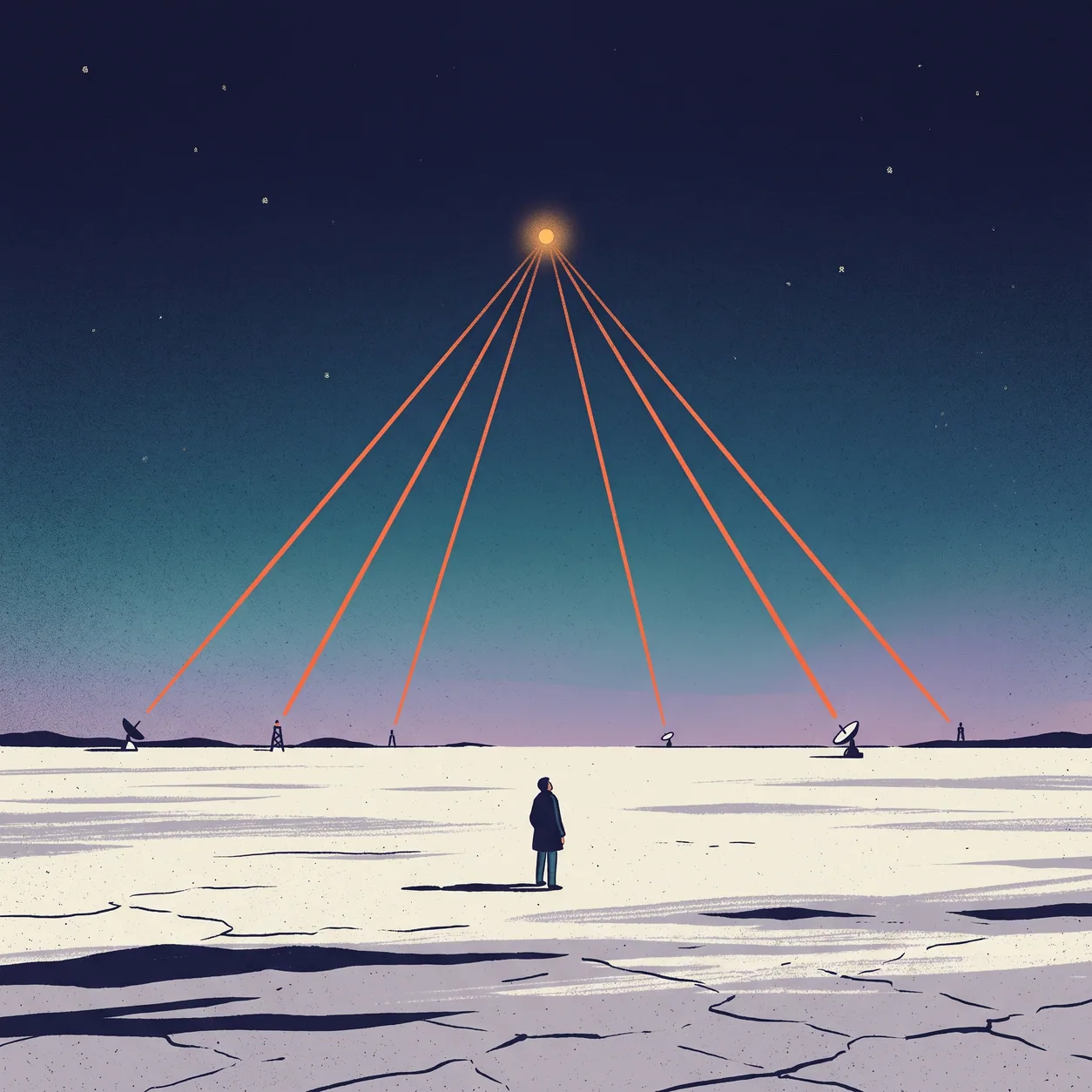
Complex engineering problems may often require combining independent components into a single virtual network. When individual tools reach physical limits, combining distributed infrastructure can perhaps yield breakthroughs that no single facility could achieve on its own. Coordinating disparate hardware under shared software protocols might open new analytical possibilities across diverse domains.
Wikipedia's current-events log for April 10, 2019 recorded that Katie Bouman and scientists at the Event Horizon Telescope project released the first ever photograph of the event horizon of a black hole. EHT researchers revealed in coordinated press conferences across the globe that they had succeeded. The Event Horizon Telescope is described as a planet-scale array of eight ground-based radio telescopes forged through international collaboration, designed to capture images.
The black hole at the center of Messier 87 resides 55 million light-years from Earth and has a mass 6.5 billion times that of the Sun. The NSF said VLBI allows the EHT to achieve an angular resolution of 20 micro-arcseconds, enough to read a newspaper in New York from a sidewalk café in Paris. NSF has directly funded more than $28 million in EHT research, the largest commitment of resources for the project.
How Distributed Networks Might Virtualize Giant Instruments
For system builders, this achievement may demonstrate how synthetic architecture can overcome physical hardware constraints. Rather than attempting to construct an impossibly large single sensor, coordinating multi-node arrays could enable teams to synthesize immense resolution across vast distances. Such integration arguably relies as much on algorithmic synthesis and aligned protocols as it does on physical hardware installation. When datasets are gathered across multiple endpoints, software alignment can perhaps convert fragmented inputs into a coherent, actionable signal. Designing systems capable of processing such distributed data streams could reframe how complex physical phenomena are measured and understood.
Why Long-Term Commitment Could Be Essential for Systems Execution
Complex undertakings may also illustrate the role of sustained operational support over extended timelines. Large-scale technical innovations may rarely emerge overnight; instead, long-term capital allocation and sustained alignment across institutions can allow engineering teams to refine measurement techniques. Builders facing massive physical or computational hurdles might consider how patient resource allocation can unlock fundamentally new operational capabilities.
Building virtualized systems across vast distances could ultimately prove that distributed execution can make the previously impossible visible.
Sources
- Portal:Current events/2019 April 10 (revision 892130603) - Wikipedia, April 12, 2019
- Astronomers Capture First Image of a Black Hole | ESO - European Southern Observatory, April 10, 2019
- Astronomers capture first image of a black hole | NSF - National Science Foundation - National Science Foundation, April 10, 2019